It was like a church to me.
I entered it on soft foot,
Breath held like a cap in hand.
It was quiet.
What God was there, made himself felt,
Not listened to, in clean colours
That brought a moistening of the eye,
In movement of the wind over grass.
There were no prayers said. But stillness
Of the heart’s passions—that was praise
Enough; and the mind’s cession
Of its kingdom. I walked on,
Simple and poor, while the air crumbled
And broke on me generously as bread.
–R.S. Thomas
—– Opening poem chosen and read by Amy W.

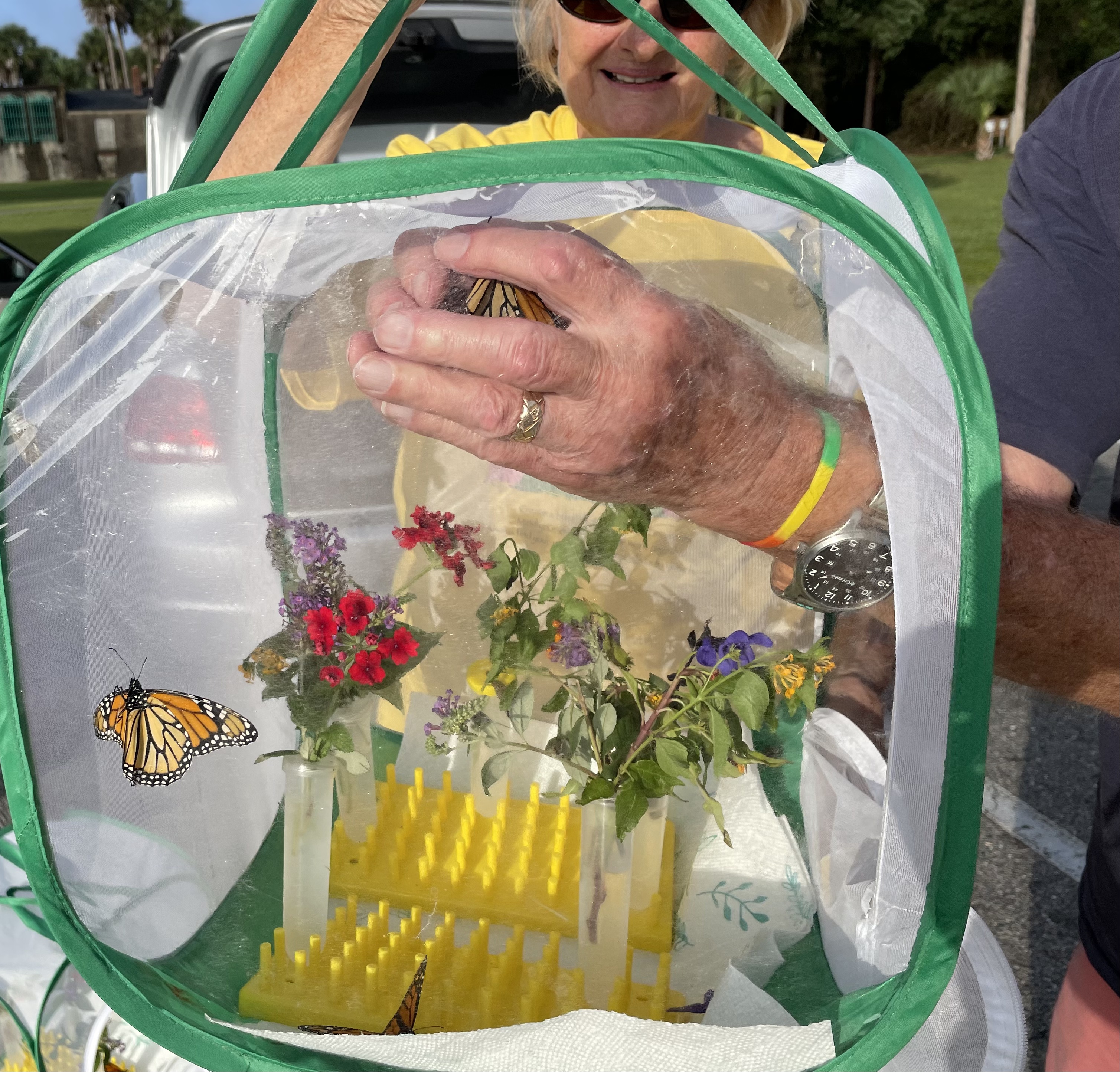
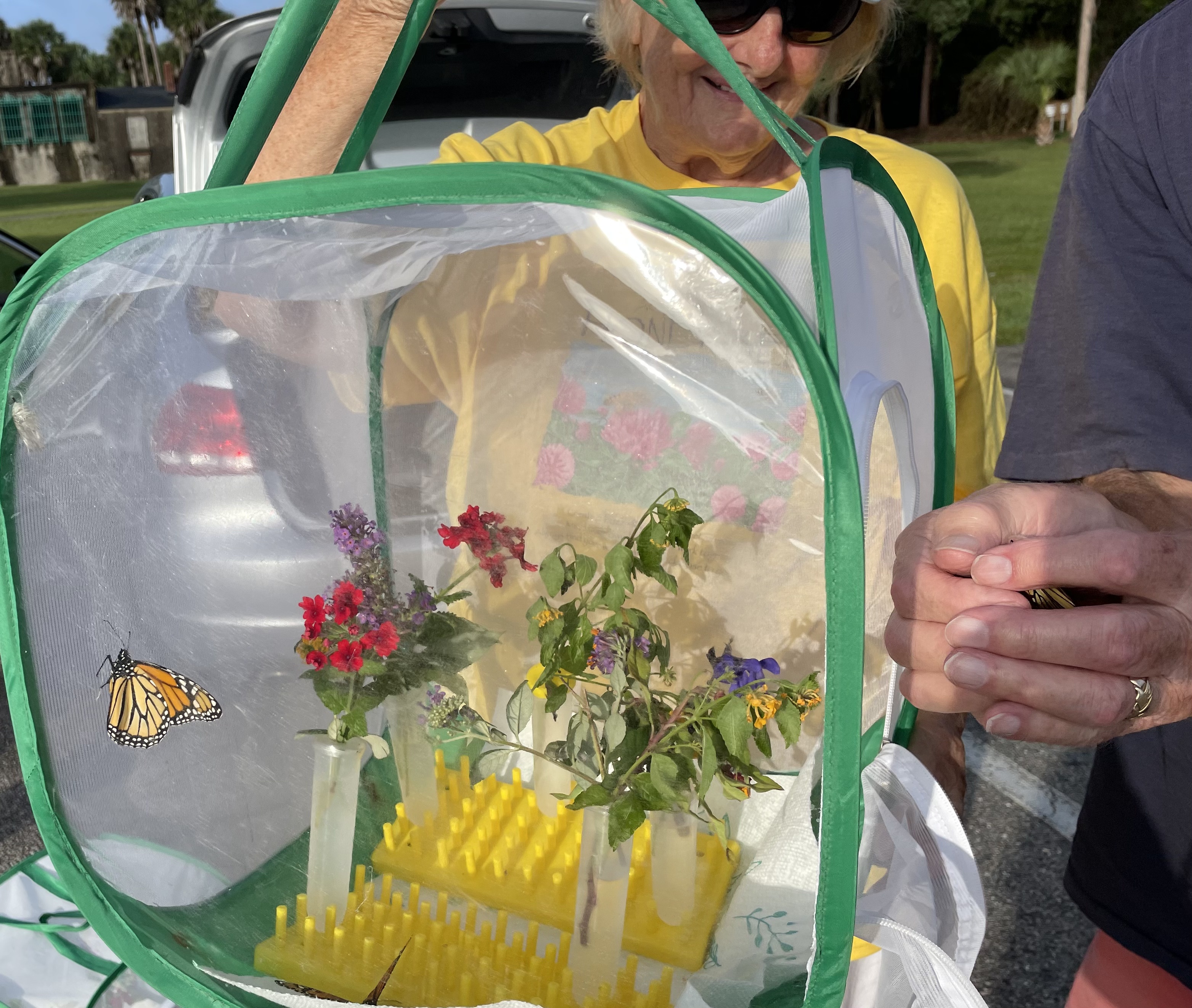
Photos by Nancy L.
We had the incredible opportunity to experience the beauty and wonder of releasing monarch butterflies that have been nurtured by the loving hands of Walt and Jean Wist, our WiW companions. What pure joy! The narrative below by Walt and Jean explains this awe-inspiring process of the metamorphosis.
…………………………………
Our Walk began with releasing five butterflies that had been birthed in 2 screen cages the day before. They were not released sooner because of heavy rainstorms. Here is some background about us and the Monarchs:
Walt was born in The Bronx. He had heard about butterflies. Jean grew up by Cape Cod. She had seen butterflies. That was back in the 1930’s and 40’s. Leaping forward to May 2019, we moved to Pawleys Island. We planted a pollinator garden for butterflies and hummingbirds in front of our cottage. Come September, we had no idea who the caterpillars were that were eating all the leaves off our plants. We threw them in the garbage can. When we woke up the next morning, we both realized those were the caterpillars who metamorphosed into butterflies. Out to the garbage can (which fortunately had nothing else in it), tip it over, gather all the caterpillars, and put them back on the plants.
Now to the Monarchs life: Metamorphosis has 4 stages: egg, larva, pupa or chrysalis, and adult.
Stage 1, the EGG. 3-5 eggs are usually laid on the under-part of the leaf (hidden)—extremely small and hard to see. Eggs are only laid on milkweed plants since caterpillars will only eat milkweed. Eggs hatch 4 days after they are laid. The female butterfly secretes a small amount of glue to attach the eggs directly to the plant. Female monarch butterflies lay 300-500 eggs over two to five weeks of egg laying.
The 2nd stage, LARVA, the monarchs remain in the egg stage of their life cycle for 3-5 days, depending on the temperature. It is during this stage that monarchs do all their growing; in fact, this is just about all that they do. These “eating machines” take few breaks even for resting. The entire larval stage in monarchs lasts from 9-14 days under normal summer temperatures. As the caterpillar grows and becomes too large for its skin, it molts, or sheds its skin. From the first 3 days of this period to the last days of it, the caterpillar will grow from ¼ “to 1 ¾ “.
Stage 3…. When the caterpillar is full grown and stops eating, it becomes a PUPA—more frequently called CHRYSALIS. In nature it climbs to the under part of a leaf and attaches itself. We bring it into a screened cage in our home, where it has a 90% chance of survival, instead of 10% in nature. It climbs to the top of the cage. Attaches itself by a strand of silk, curls up, hangs up-side-down, and forms the chrysalis around it.
This stage can last a few weeks to a month. It may look like the chrysalis is just hanging there, but a lot is going on. Toward the end of this stage, it may be possible to see the outline of the legs, wings, eyes of the adult butterfly.
The 4th stage produces the Monarch ADULT BUTTERFLY. This stage of development lasts eight to fifteen days under normal summer conditions. While still holding on to the chrysalis, the butterfly will start to flap its wings to dry them out. It will release itself from the chrysalis and fly around in the cage. After a couple hours, we will release them. They can fly away immediately by using their large and colorful wings. The one thing they cannot do is grow. They will always remain their “birth size.”
What a great paradigm of life!
- What does it take for me to grow into a beautiful butterfly?
- What and how do I “deconstruct” so that it’s possible to “reconstruct”? Into what?
- Is it possible for me to grow after birth, or has DNA established my future?
- What can you add to these thoughts?
Our walks always help us think of and recall life in the past. These reflections bring us into the present and the future. This is truly remembering. I prefer to consider the word “literally”—
re-member. Why do we need to re-member? Is it because we have been dis-membered? What is it going to take to get us/me back together again?
So many questions come up. This leads to the Who? What? When? Why? How? My “Walk in Wonder” has me wondering about the present and future?
It is time to get back to the Monarchs. The Monarchs can help me get an understanding of what is yet to be for me. Through 4 stages they were dis-membered, and then re-membered into something more spectacular. The “Wonder” keeps coming out: Was God aware that these thoughts,
re-membrances, of butterflies would affect the understanding of my life yet to be?
A final word for contemplation: “There is no resurrection without death.”
On another note, these are the numbers—
2019 we had 1 generation 12 butterflies were released mid Sept, from trash can caterpillars
2020 we had 3 generations 40 butterflies were released
from generation 1 &2 28 butterflies were released no dates available
the 3rd generation 12 butterflies were released from Nov 14-19 – very late in the year
2021 the 1st generation 86 butterflies were released from Aug 23-31
the 2nd generation 96 butterflies were released from Sept 18-Dec 12
2022 the 1st generation 15 butterflies were released from Aug 17-31
We have been very aware of the change and drop in the number of Monarchs this year. I “Walk in Wonder” as to what else in life is being affected?
— Reflection by Walt and Jean Wist
 walkinginwonderhcfm